Poole's Twin Sales Bridge
Technical Research Synthesis: Operational Reliability and Strategic Investment in the Twin Sails Bridge, Poole, Dorset
1. Strategic Context and Project Genesis
The Twin Sails Bridge (TSB) in Poole, Dorset, is a major element of local and regional infrastructure, designed not only to alleviate congestion on the pre-existing Poole Bridge (built in 1927) but also to act as a catalyst for economic growth in the Hamworthy and Holes Bay areas. Its commissioning was a direct response to increasing traffic levels and the necessity of maintaining robust access to the commercial Port of Poole and its ferry terminal.
1.1 The Imperative for Dual Connectivity: Strategic Importance of the Poole Harbour Crossings
The requirement for the TSB arose from a recognition that reliance on a single movable crossing—the original Poole Bridge—created unacceptable levels of risk for the local and regional economy. The TSB provides a crucial secondary road link, spanning the Backwater Channel in Holes Bay, connecting Poole Town to Hamworthy. The dual-bridge system is essential for maintaining full access to the Port of Poole from the Strategic Road Network, particularly for freight transport.
The importance of this infrastructure network is underscored by its usage statistics: the TSB and Poole Bridge collectively manage a substantial daily traffic load, supporting over 20,000 journeys each day, including vehicles, pedestrians, and cyclists. Furthermore, the operational demands placed on these structures are exceptionally high for movable bridge infrastructure. At their busiest, the two bridges execute approximately 6,000 lifts per year. This high frequency of operation imposes intense cyclical loading and fatigue stress on the mechanical components, particularly the lifting mechanisms and bearings. The high demand environment is a significant factor in the system’s observed performance deficiencies.
The chronic unreliability experienced by the TSB since its opening fundamentally jeopardizes the intended strategic objective of providing network resilience. Frequent and prolonged closures, such as the nearly four-month closure in 2024 , negate the core benefit of the dual-bridge system, forcing traffic back onto the original Poole Bridge and resulting in community severance and significant disruption. The ongoing requirement for substantial capital expenditure to correct inherent reliability issues reflects the difficulty in maintaining the critical ‘two-bridge’ system necessary to support regeneration and accommodate planned growth.
1.2 Historical Development and Commissioning Timeline
The journey to construct the Twin Sails Bridge was protracted, characterized by decades of deliberation and planning. Initial suggestions for a second crossing were floated in the 1980s. The design competition, which ultimately led to the selection of the innovative concept, was won in 2002. Although the concept received formal approval in 2006, the project was immediately subject to delays due to complex issues involving land ownership and subsequent public inquiries.
Construction finally commenced in 2010, with Hochtief (UK) Construction acting as the main contractor. Eadon Consulting provided essential support for the delivery of the mechanical, electrical, and hydraulic equipment. After a construction period focused on complex assembly, including lifting the 160-tonne structure into place and extensive testing of the hydraulic systems, the Twin Sails Bridge officially opened to vehicles, pedestrians, and cyclists on 4 April 2012.
2. Engineering Profile and Mechanical System Analysis
The Twin Sails Bridge is recognized as a significant modern engineering feat, distinguished by a design that prioritizes both structural function and architectural aesthetics.
2.1 Architectural and Structural Design: The Iconic Triangular Bascule
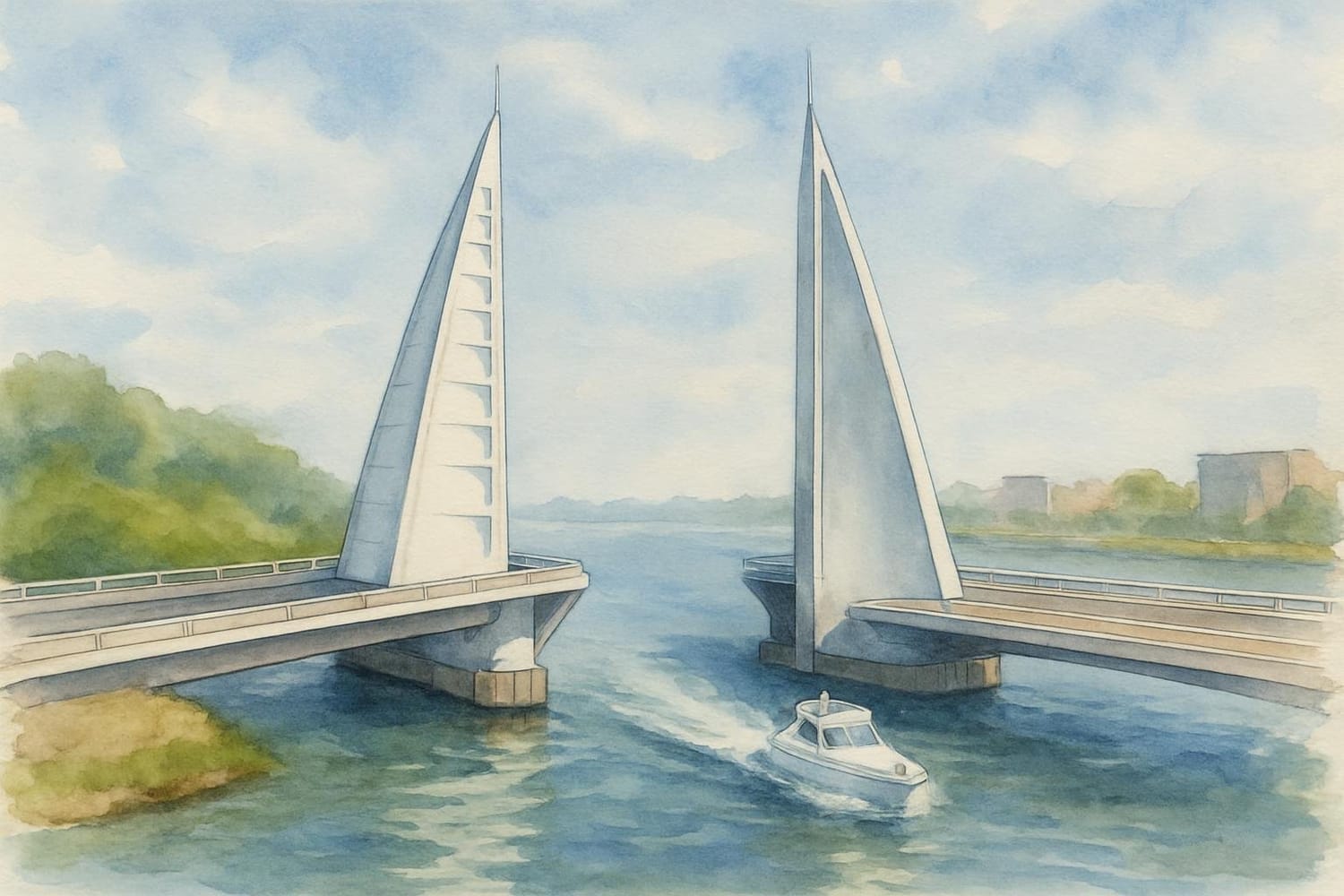
Structurally, the TSB is a 140-meter, five-span double-leaf bascule bridge. Its design is notable for being the world's first triangular lifting bridge. This unique geometry results from the bridge deck being obliquely dissected, creating two long, opposing triangular lifting leaves that resemble sails when raised.
The structure is substantial, comprising 41 individual steel sections, some weighing up to 200 tonnes. The two opening leaves are each 23 meters high and weigh 65 tonnes. Approximately 900 tonnes of steel were supplied by Cleveland Bridge UK. The bridge is founded on 50 concrete piles driven 31 meters deep into the tidal channel. When lifted, the two spans provide a clear navigational channel 19 meters wide for maritime traffic.
The architectural design, led by Wilkinson Eyre Architects, has been widely praised for its elegance and functional efficiency. Beyond daylight aesthetics, the bridge incorporates a sophisticated lighting system designed to accentuate its form and operational sequence. The bridge features integrated functional lighting, and when open, an animated sequence sees the walkway's white light transition to a dramatic red glow, heightening the experience of the opening spectacle.
2.2 Detailed Analysis of the Hydraulic Lifting Mechanism
The mechanical complexity of the TSB lies within its hydraulic actuation system. This double bascule design employs twin hydraulic rams/cylinders for each of the two bridge leaves, resulting in a total of four primary lifting cylinders. These rams enable the rapid lifting and lowering process, which takes approximately two minutes to achieve full opening. The system was designed with inherent redundancy, allowing for essential operations—such as planned maintenance or emergency movements—to be conducted in a "single cylinder mode".
The structural configuration, combining a unique triangular geometry with an oblique bascule joint, presents inherent challenges to the mechanical system stability and component durability. The high aesthetic value derived from the tapering, sail-like geometry may place non-standard or disproportionate stress on the pivot bearings and hydraulic components during the frequent lift cycles. This potentially complex load path, involving torsional and lateral forces beyond the design expectation for a typical perpendicular bascule, appears to be the primary factor undermining the bridge’s reliability. The recurrent mechanical failures, particularly involving the bearings and rams , indicate that the original component specification or the design interface between the structural steel and the mechanical actuation system was insufficient to manage the high operational frequency and resulting fatigue loading.
A critical vulnerability identified in the maintenance process is the dependency on highly specialized components. Council operations staff confirm that failed parts, such as those required for the hydraulic cylinders, must be custom-manufactured from "very strong forged steel" and are not readily available off-the-shelf. This proprietary nature of the lifting mechanism components significantly increases the lead time and complexity of repairs, directly contributing to the prolonged closures that frustrate users. This lack of standardization justifies the need for the forthcoming strategic redesign—a move toward a system with greater mechanical robustness and potentially improved component logistics.
3. Financial Framework and Capital Expenditure Review
The financial planning for the Twin Sails Bridge involved significant capital investment, followed by substantial corrective expenditure necessitated by premature operational failure.
3.1 Original Capital Project Cost Breakdown (2012)
The Twin Sails Bridge project, spanning its full lifecycle from initial concept to completion, represented a major capital scheme. The total budgeted cost for the project was approximately £37 million. This figure covered a broad range of infrastructure and planning activities essential for such a complex landmark project.
The core construction contract for the bridge itself was valued at £18.562 million, awarded to Hochtief (UK) Construction. However, project costs extended far beyond the physical construction. Substantial elements of the £37 million budget included:
£3.347 million for link road development and land acquisition.
£1.730 million for the Variable Message Signage (VMS) road system and marine public inquiry requirements.
£8.0 million allocated to cover consultancy, design, preliminary work, environmental assessments, and the detailed planning and procurement phases.
A contingency fund of £3.715 million.
3.2 Post-Commissioning Financial Liabilities and Corrective Capital (2025-2028)
Only a little over a decade after its opening, the TSB is requiring significant investment to address fundamental mechanical reliability issues. BCP Council approved a £6 million funding allocation earlier this year for long-term improvements targeting both the TSB and the older Poole Bridge.
This substantial corrective expenditure, equivalent to approximately 32% of the original construction contract price, represents an unforeseen liability in the Total Cost of Ownership (TCO) for the structure. The need for such investment signals significant performance shortcomings in the original design or execution. Given the Head of Engineering’s conclusion that "increment improvements" were insufficient and a "redesign" is necessary , the expenditure effectively becomes a capital cost to rectify original design flaws. This preventative investment is strategically vital, as the council recognized that mitigating the current reliability issues is essential to avoid "higher level future years disruption and maintenance costs due to costly unplanned repairs".
A notable aspect of this financial strategy is the funding source: the entire £6 million allocation is drawn from the strategic Community Infrastructure Levy (CIL). CIL funds are developer contributions specifically reserved for capital projects. The reliance solely on this mechanism means the cost of rectifying the infrastructure failure does not impose an additional burden on local Council Taxpayers. This strategic financial decision ensures that critical infrastructure resilience is achieved without compromising the council's general revenue budget.
4. Operational History, Failures, and Reliability Assessment
The operational history of the Twin Sails Bridge has been marked by a recurring pattern of mechanical failure, primarily focused on the lifting components, leading to considerable unplanned downtime.
4.1 Chronology of Reliability Failures
Since 2012, the TSB has frequently struggled with reliability. The first major recorded issue with the main lifting mechanism occurred in December 2018 when a bearing on one of the hydraulic rams for the Hamworthy leaf failed. This incident was severe enough to force the bridge to operate in its emergency single-cylinder mode for an extended period, placing undue stress on the remaining mechanisms.
The issues persisted, leading to significant disruption. On 16 January 2023, a technical fault caused a section of the bridge to snap. Most recently, the bridge was subjected to a prolonged closure, lasting nearly four months, from early July to late December of the relevant year. This closure was initiated after engineers detected "abnormal creaking noises" during a routine lift. Inspection revealed this noise was similar to the precursor symptoms observed during the 2018 bearing failure. To prevent catastrophic structural damage, the bridge was secured in the upright, open position.
The accumulation of these incidents—including the closure of the bridge three times due to lifting faults since 2012 —demonstrates that incremental fixes implemented over the years have been insufficient to address the underlying vulnerability.
4.2 Engineering Diagnosis: Systemic Component Failure
Technical analysis of the repeated failures points overwhelmingly toward a systemic flaw originating in the lifting mechanism, specifically the associated bearings and hydraulic cylinders. The mechanical and electrical manager for the council confirmed that the faults are recurring, affecting different parts of the four hydraulic cylinders.
The council’s formal engineering assessment concluded that the reliability issues are principally related to the bearings, starting around 2019. The continuous failure of these components led to the critical assessment that, based on empirical evidence of repeated malfunction, the bearings would remain unreliable and require continuous, costly replacement unless a fundamental design change was implemented. The Head of Engineering subsequently affirmed the need for this change, stating that previous efforts to perform "increment improvements" were inadequate, thus mandating a complete redesign of the mechanism.
This conclusion marks a pivotal shift in the local authority’s asset management philosophy. For several years, maintenance efforts were focused on reactive component replacement, treating the bearing failures as symptoms. The strategic commitment of £6 million towards redesign confirms an abandonment of the reactive approach in favor of addressing the mechanical root cause. The objective is to permanently modify the lifting mechanism to mitigate the design flaw that appears to subject the bearings to unacceptable stress or load profiles, thereby moving towards a stable, long-term operational footing.
The protracted nature of the 2024 closure was compounded by logistical challenges. Specialist parts made of "very strong forged steel" needed for the immediate December repair required extensive lead times for manufacturing and delivery. The dependence on bespoke, non-standard components severely inhibits the speed of repair operations. In response, the council’s Chief Operations Officer is initiating a crucial logistical mitigation strategy: procuring and storing additional material to ensure subcontractors can commence and complete urgent repairs far more quickly in the future.

5. The Strategic Resilience Programme: Immediate Action and Long-Term Redesign
The Bournemouth, Christchurch and Poole (BCP) Council has initiated a two-pronged strategy to restore and guarantee the long-term reliability of the Twin Sails Bridge: an immediate operational intervention followed by a multi-year, capital-funded redesign programme.
5.1 The Immediate December Essential Repair Intervention (Q4 2024)
The immediate repair schedule targets the restoration of the bridge following the four-month closure. Preparatory work, including site preparation, has been underway since October and November, anticipating the specialist materials required for the repairs, which were due to arrive in early December.
The critical repair work is scheduled to commence on 15 December. The expected duration of the project is approximately one week, with engineers focusing on essential repairs designed to improve the bridge's resilience and reliability for the short term. The targeted reopening date for vehicles, pedestrians, and cyclists is around 22 December, dependent upon the successful completion of critical site safety testing.
5.2 The Long-Term CIL-Funded Strategy (2025-2028)
The £6 million investment approved by BCP Council's cabinet, funded by the strategic Community Infrastructure Levy (CIL), represents the comprehensive plan for long-term systemic resilience across the Poole bridge system.
The primary element of this programme is the long-term solution for the TSB: changes to the design of the mechanism that lifts the bridges. This strategic intervention, which will be implemented in parallel with the immediate short-term repairs, aims to permanently resolve the recurring bearing and hydraulic cylinder faults. The redesign is essential because, as confirmed by engineering analysis, the existing mechanism requires such regular maintenance that its continued operational reliability cannot be guaranteed without fundamental modification.
The three-year programme also includes critical ancillary works crucial for maintaining overall network resilience:
1) Poole Bridge Refurbishment: Work on the adjacent Poole Bridge will address long-term corrosion by repairing corroded steelwork and undertaking a complete repainting of the structure. This is vital to protect the older asset from further deterioration.
2. Variable Message Signage (VMS) System Upgrade: To address public frustration caused by poor communication during previous unplanned closures, the investment includes replacing the existing, end-of-life electro-mechanical signs with four new, reliable digital information panels. This enhances the network's ability to provide real-time travel information efficiently.
The implementation is structured with procurement of specialist inputs and detailed design processes prioritized during the current financial year, followed by the main engineering work phases over the subsequent three years. This strategic phased approach aims to increase the life of critical components, significantly reduce the frequency of unplanned repairs, and ultimately guarantee the long-term viability of the dual-bridge system.
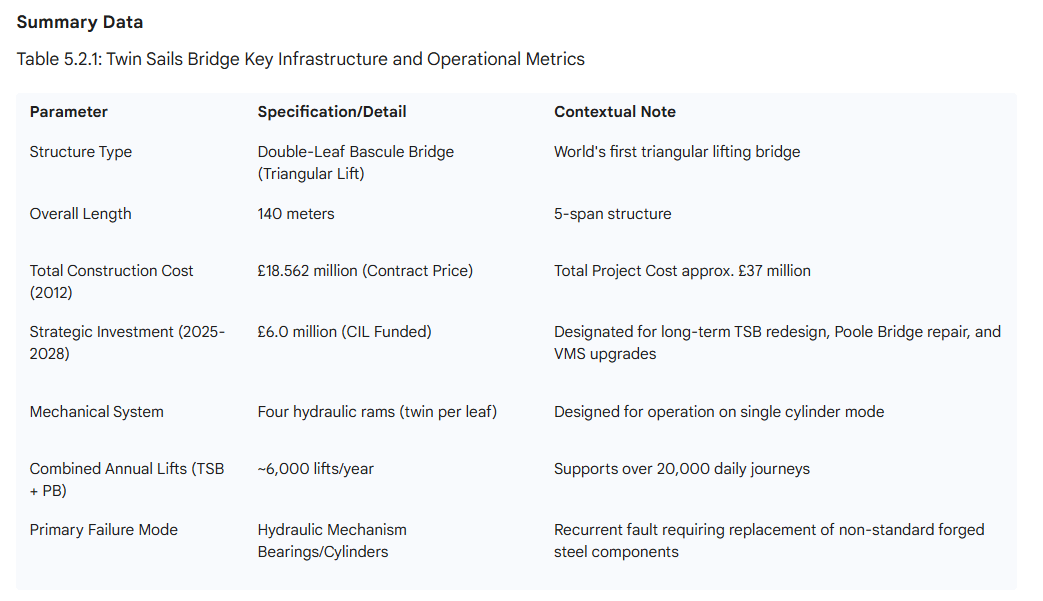
The following table summarizes the key engineering, financial, and reliability data points for the Twin Sails Bridge.
6. Conclusions
6. Conclusions
The Twin Sails Bridge, while successful in its architectural ambition and its initial objective of supporting regeneration in Poole, has demonstrated severe structural and mechanical reliability deficits since soon after its 2012 commissioning.
The analysis confirms that the bridge’s high aesthetic value, rooted in its unique triangular bascule design, introduced mechanical complexities—specifically uneven loading—that exceeded the tolerance of the original hydraulic lifting mechanism bearings and cylinders. This is evidenced by the consistent recurrence of bearing failures since 2018, resulting in prolonged closures and the strain placed on the system by operating long-term in emergency single-cylinder mode.
The current December essential repair work, necessitated by the four-month closure in 2024, is an immediate operational requirement to restore network flow before the Christmas period. However, this is distinct from, and secondary to, the major strategic investment approved by BCP Council. The commitment of £6 million in CIL funding represents a critical pivot in asset management strategy: a shift from costly, short-term component replacement to a mandated, long-term redesign of the core lifting mechanism. This capital injection, representing a significant post-commissioning expenditure, is structurally necessary to achieve the long-term operational reliability that the original design failed to deliver. The comprehensive programme, including the refurbishment of Poole Bridge and the upgrade of VMS signage, demonstrates a systemic approach to securing the resilience of the entire Poole Harbour crossing network over the next three years.
YOU MIGHT LIKE

Updated Regularly
News From a Wider Area
POPULAR POSTS

Popular Events Will Appear Here
Popular BCP News Will Appear Here
Popular National News & Beyond
NEWSLETTER
It's FREE To Join Our Email Updates - Keep up to date with latest events, local news & articles!
Created with Systeme.io