The Industrial Behemoth of Holes Bay
... Comprehensive History and Analysis of Poole Power Station (1947–1993)
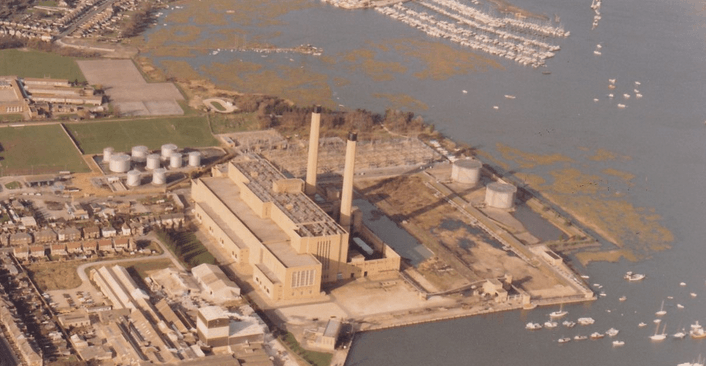
The industrial evolution of the British South Coast is nowhere more poignantly illustrated than on the thirty-acre stretch of reclaimed mudland in Hamworthy, Poole. For nearly half a century, the Poole Power Station stood as a sentinel of post-war reconstruction, a titan of brick and concrete that promised modernization and energy security to a nation emerging from the darkness of global conflict. Between 1947 and 1993, this facility was not merely a utility; it was the tallest landmark in Dorset, a major employer, and a social hub that defined the skyline and the collective identity of the region. Today, however, the site exists in a state of profound architectural and economic limbo, serving as a silent witness to the complexities of urban regeneration, environmental regulation, and the shifting priorities of the twenty-first century. The ongoing "Power of Poole" exhibition at Poole Museum, running until August 2026, serves as a vital anchor for this research, inviting the community to reconnect with a history that is literally buried beneath the concrete rafts of Hamworthy.
The Post-War Industrial Imperative and the Birth of a Giant
The origins of the Poole Power Station are rooted in the urgent necessity of the mid-1940s. Britain’s infrastructure had been ravaged by the Second World War, and the subsequent drive for modernization required a massive increase in electricity generation capacity. The Bournemouth and Poole Electricity Supply Co. initiated the project in 1947, envisioning a facility that would integrate the latest in thermal power technology to support the burgeoning energy demands of southern England. This period saw the transition of the UK energy sector from a fragmented collection of local suppliers to a nationalized grid, with the British Electricity Authority (BEA) taking ownership in 1948, followed by the Central Electricity Authority in 1955 and the Central Electricity Generating Board (CEGB) in 1958.
The choice of Hamworthy as a location was dictated by several critical geographic and logistical factors. First, the site’s proximity to Holes Bay offered an inexhaustible supply of seawater - approximately eight million gallons an hour - required for the condensing processes of the steam turbines. Second, the upstream position from Poole Bridge allowed for the delivery of coal by sea, utilizing a dedicated fleet of colliers that could navigate the harbour to deliver the lifeblood of the station’s furnaces. The authorization of the station in 1946 marked the beginning of one of the most ambitious engineering projects in the history of Dorset.
Engineering the Unstable: Reclaiming the Mudlands
The engineering challenges of building such a massive structure on the soft mudflats of Holes Bay cannot be overstated. The land itself, largely reclaimed from the intertidal zones, lacked the natural strength to support the weight of a heavy industrial plant. Before the first brick could be laid, a Herculean effort in land reclamation was required. Approximately 250,000 tonnes of chalk were transported from a quarry in Sturminster Marshall to stabilize the thirty-acre site. This massive importation of material was supplemented by 24,000 tonnes of ash to raise the site level and mitigate the risk of flooding from the harbour.
The stabilization process had immediate and visceral effects on the local community. Fred Winwood, a civil engineer on the project and later Mayor of Poole, recalled that the sheer volume of chalk dust turned the rooftops of Hamworthy white, resembling a permanent layer of snow. This two-metre-deep chalk base provided a working surface for heavy machinery, but the true structural integrity lay deeper. The turbine house and boiler-house were designed to rest on a mass concrete raft measuring 500 feet by 248 feet. This three-acre slab, varying in depth from 15 to 30 feet, was recognized at the time as the largest single concrete block ever formed in Britain, weighing an estimated 150,000 tons.
To anchor the structure against the shifting coastal silts, engineers drove approximately 2,000 reinforced concrete piles into the ground. These piles, ranging from 30 to 50 feet in length, reached down to the stable white clay layer buried deep beneath the mud. This foundational redundancy was essential not only for the main buildings but also for the twin 325-foot chimneys, each of which required 168 piles to support their 2,240-tonne weight.
Architecture and Local Craftsmanship: The Brickwork Narrative
While the power station was a piece of national infrastructure, its physical form was deeply rooted in local industry. The massive steel-framed building was clad in approximately six million bricks, manufactured by local firms such as Sykes & Sons of Creekmoor and the Upton Brick Works. These three-colour bricks were chosen for their durability and aesthetic quality. Fred Winwood and other contemporaries noted that the station was a more "attractive" and "better built" building than many modern developments, utilizing local clay that had been a staple of Poole's economy for centuries.
The boiler house, standing at 130 feet, was the highest building on the site, but it was the chimneys that defined the skyline. Measuring 27 feet in diameter at the base and tapering to 19 feet at the top, they were the tallest structures in Dorset until their demolition. The construction of these chimneys was a perilous undertaking. In one tragic incident during their ascent, a lift crashed 120 feet, resulting in severe injuries and one fatality. This starkly illustrates the human cost of the industrial progress that the station represented. The workforce responsible for these feats included a significant number of Irish labourers, many of whom lived on-site in mobile homes, earning approximately £15 a week - a substantial wage for the era but earned through high-risk labour.Lorem ipsum dolor sit amet, consectetur adipisicing elit. Autem dolore, alias, numquam enim ab voluptate id quam harum ducimus cupiditate similique quisquam et deserunt, recusandae.
Mechanical Specifications and Power Output
The station was a marvel of mechanical engineering, housing a diverse array of turbo-alternators and boilers that reflected the peak of mid-century British industrial capability.
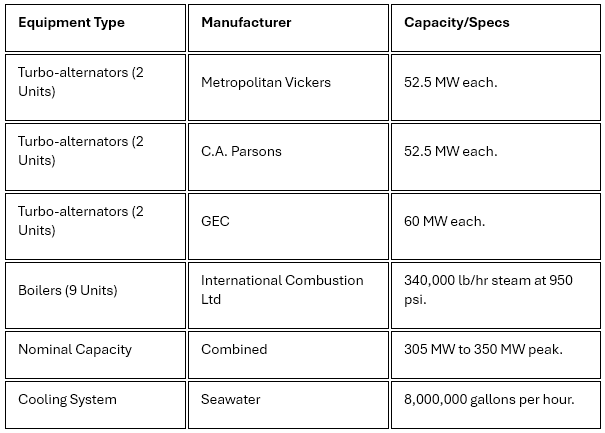
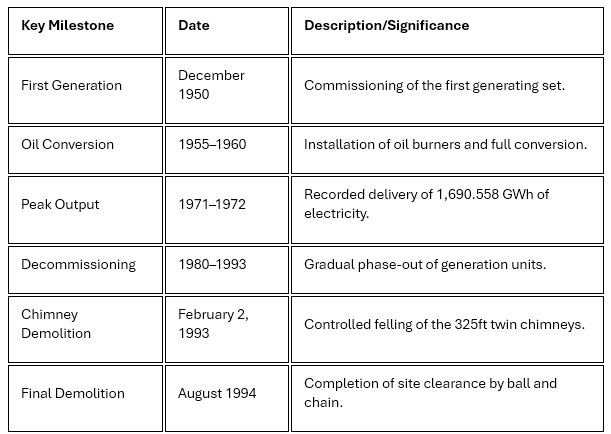
The first generating set was commissioned in December 1950, with subsequent units following in 1951, 1952, and 1958. The station’s nine pulverised fuel superheating boilers operated at 940 °F (504 °C), driving the turbines to produce enough electricity to supply approximately 400,000 homes at its peak.
Socio-Economic Impact: The Pulse of Hamworthy
At its height, the Poole Power Station was the socio-economic heartbeat of Hamworthy, employing nearly 400 people. It was more than a place of work; it was a social hub. The site featured its own social clubs and venues, providing a sense of community for families who, in some cases, lived directly on the construction site. John "Paddy" Reynolds, the first man on the construction site, lived in a mobile home with his family; his daughter, Margaret, holds the distinction of likely being the only baby ever born on the power station grounds.
However, the station's presence was a dual-edged sword. While it provided economic stability, it also imposed an environmental burden on the residents. In November 1959, Poole MP Sir Richard Pilkington raised concerns in Parliament about the "blanket of soot and grease particles" that would ruin gardens, cars, and even burn clothes. On humid days, emissions would condense into droplets that fell on the neighbourhood, leading to a complex "love-hate" relationship between the town and its industrial giant.
The Turlin Moor Legacy: Fly Ash and Land Reclamation
The impact of the station extended beyond its thirty-acre footprint through the disposal of fly ash - the fine particulate residue of coal combustion. Disposal of fly ash was a massive logistical challenge, with the station producing over 1,000 tonnes of coal waste daily. In a pragmatic but environmentally significant move, this ash was used to reclaim land across Hamworthy, most notably for the playing fields and recreation grounds at Turlin Moor.
While this provided the community with much-needed amenity space, it left a lasting geochemical legacy. Modern studies on coastal landfills have highlighted that such "controlled tipping" in the 1920s to 1960s often lacked the rigorous containment measures required today. The depth of the fill and its geochemical interaction with the harbour waters remain a subject of interest for environmental wardens and researchers monitoring the ecological health of Holes Bay.
Transition, Decline, and the Oil Crisis
The station’s operational life was dictated by the volatile global energy markets of the mid-20th century. Originally coal-fired, the station began its conversion to oil in 1955, with full conversion of the boilers completed by the late 1950s. This transition allowed the station to diversify its fuel sources, but it also made the facility vulnerable to the 1970s oil crisis. As oil prices surged, the cost-effectiveness of the Poole plant declined compared to newer, more efficient coal or nuclear stations on the national grid.
Decommissioning began in stages during the 1970s. By the early 1980s, the station had effectively ceased regular generation, serving only as a standby facility. In the year ending March 1981, the station delivered a mere 88 MWh of electricity, a fraction of its former output. Despite the end of power generation, the station remained a dominant feature of the skyline for another decade until National Power finally announced its demolition.
The Spectacle of Demolition: February 1993
The demolition of the Poole Power Station was one of the most significant public events in the town's modern history. On February 2, 1993, at approximately 10:00 am, the 325-foot chimneys were brought down with high explosives in front of a crowd of 7,000 to 10,000 people. The event required the closure of major roads and the evacuation of local homes, turning the industrial decommissioning into a town-wide spectacle.
The demolition continued through 1993 and 1994. Eight coal bunkers, containing 1,600 tonnes of steel, were blown up in December 1993 using over 100 lbs of explosives. The main building, which contained a staggering 14,000 tonnes of steel and brickwork, was demolished in March 1994. By August 1994, the last corner of the structure was levelled using a ball and chain, leaving only the massive concrete raft as a subterranean tombstone for the industrial era.
The Era of Limbo: Failed Schemes and Brownfield Challenges
Since 1994, the site has remained a vacant brownfield plot, frequently described as the largest such regeneration opportunity in the South West. Its history over the last thirty years is a chronicle of stalled ambition and economic frustration. For over two decades, the site was owned by private entities, including RWE, L&Q Estates, and Lands Improvement Holdings.
One of the most prominent failed initiatives was the Gallagher UK "Hamworthy Urban Village" scheme in the early 2000s, which proposed up to 1,350 homes and a quayside inspired by the historic Poole Quay. The developers planned to build directly on the existing concrete raft to minimize groundwork costs, but the project ultimately foundered due to the "exceptional costs" of the site. These costs included the relocation of an active electric switching station - estimated at £20 million - and the necessity of significant flood defence works and contaminated land remediation.
The 2020 BCP Intervention and Public Ownership
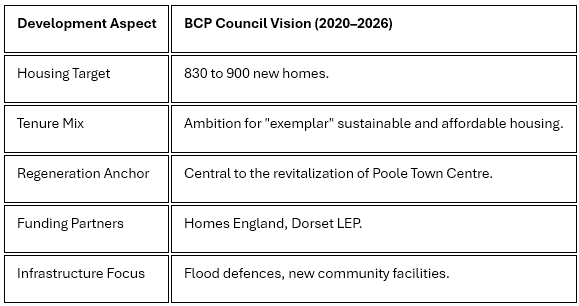
In June 2020, BCP Council intervened to break the deadlock, approving a £5 million purchase of the 40-acre site from L&Q Estates. The council's strategy was to bring the land into public ownership to de-risk the development and attract investment that the private sector had previously shunned. The vision for the site, now often referred to as the "Holes Bay" regeneration project, includes at least 830 new homes and significant commercial space.
Modern Barriers: Nutrient Neutrality and Ecological Constraints
The path to regeneration has encountered a new and complex legal landscape in the 2020s. The primary obstacle today is "nutrient neutrality." Poole Harbour is a designated nutrient-sensitive catchment, and since 2022, Natural England has mandated that any new residential development must prove it will not increase the discharge of nitrogen or phosphorus into the harbour.
This requirement has effectively halted the construction of thousands of homes in the BCP area. For the Holes Bay site, the council must now navigate a "credit-based approach" to nutrient mitigation, often involving the creation of new wetlands or the retirement of agricultural land elsewhere in the catchment to offset the impact of the 900 proposed homes. Furthermore, the site's long dormancy has allowed nature to reclaim the land. The dense growth of weeds and vegetation has led to concerns that the site might now be classified as a biodiversity net gain asset, potentially granting legal protection to the very "wasteland" the council seeks to develop.
Residents have observed contractors in protective gear conducting environmental surveys, highlighting the tension between urban housing needs and modern ecological standards.
The Power of Memory: Poole Museum and the Co:Lab
While the physical site remains in a state of suspended animation, the cultural memory of the station is more active than ever. The "Power of Poole" exhibition at Poole Museum (2026) serves as a critical bridge between the industrial past and the uncertain future. By collecting oral histories and rarely seen artifacts from the station’s operational years, the museum is building a "shared community archive" that ensures the human stories of the 400 workers and their families are not lost.
This exhibition acts as a social "reclamation" of the site, paralleling the physical reclamation of 1946. It invites the public to view the station not just as a source of soot or a demolished landmark, but as a "symbol of modern Britain" that powered the region’s growth. The artifacts on display, from control room dials to photographs of the social club, remind visitors that the currently empty waterfront was once a place of intense human energy and economic production.
Conclusion: From Industrial Giant to Urban Village
The trajectory of the Poole Power Station site - from 250,000 tonnes of chalk to an empty field of weeds - encapsulates the broader challenges of the UK's post-industrial transition. The engineering miracle of the 1940s, which stabilized the mud of Holes Bay with millions of bricks and the "biggest lump of concrete in Europe," has given way to a 21st-century puzzle of environmental regulation and market viability.
The station’s former industrial dominance was absolute; its chimneys were the compass points for the entire county. Its current status as an empty waterfront site is a stark contrast, but it is also a site of immense potential. The BCP Council's 2026 Growth Plan and the ongoing partnership with Homes England represent the latest, and perhaps most robust, attempt to resolve the site's limbo. Whether the site becomes a "sustainable urban village" or remains a brownfield monument to the past depends on the successful navigation of nutrient neutrality, infrastructure funding, and the enduring community spirit captured in the halls of Poole Museum.
The power of Poole is no longer measured in megawatts, but in the resilience of its residents and the persistence of its urban vision.
YOU MIGHT LIKE

Updated Regularly
News From a Wider Area
POPULAR POSTS

Popular Events Will Appear Here
Popular BCP News Will Appear Here
Popular National News & Beyond
NEWSLETTER
It's FREE To Join Our Email Updates - Keep up to date with latest events, local news & articles!
Created with Systeme.io