What IS Happening To The Old Barclays House Building?
The redevelopment of the former Barclays House on Wimborne Road in central Poole, Dorset, represents a critical case study in architectural adaptive reuse, urban regeneration, and brownfield development.
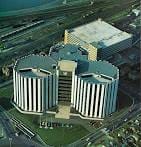
Constructed between 1972 and 1975 by Wilson, Mason, and Partners, this massive Brutalist landmark—defined by its three iconic octagonal wings—was the result of Barclays’ 1970s strategy to decentralize its operations out of London. For over four decades, it dominated the Poole skyline and served as an economic anchor.
1. Timeline of Vacancy and Planning Approval
The transition of Barclays House from a commercial hub into high-density housing followed a complex, high-stakes timeline.
January 2022 – Vacancy: Barclays officially vacated the premises, transferring remaining staff to a downsized footprint in the Lansdowne area of nearby Bournemouth. The site was put up for a sealed-bid auction.
The BCP Council Bid Controversy: The newly formed Bournemouth, Christchurch and Poole (BCP) Council initially emerged as the highest bidder, offering a staggering £17 million (nearly triple the market value next bid). However, following a rigorous £195,000 technical due diligence phase exploring municipal uses, the council withdrew its bid in September 2022 after identifying massive hidden liabilities in the structure's integrity and hazardous materials.
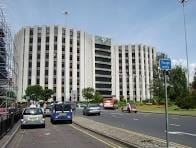
October 2022 – Removal of Branding: The removal of the iconic blue Barclays eagle logo from the building’s exterior signaled the absolute conclusion of its financial era, leaving the asset "abandoned" and boarded up by early 2023.
June 2024 – Planning Approval: After the site was acquired by private developers (VCRE Four Poole Limited) for roughly £5.3 million, BCP Council officially granted planning permission for a Build-to-Rent (BTR) scheme designed by ARC Architecture. The approved scheme allows the conversion of the vacant office space into 362 residential apartments.
2. Architectural Strategy: Facade Retention vs. Demolition
During the site's transition, developers faced a stark architectural dichotomy: demolish the Brutalist behemoth entirely or structurally adapt it.
The Demolition Argument
Local developers (such as Fortitudo) heavily advocated for full demolition, applying for prior approval to flatten the site and erect three separate, modern apartment blocks. Proponents of demolition argued that Brutalist architecture is notoriously difficult to convert due to deep floor plans, low thermal efficiency, and inflexible concrete floor plates. Economically, demolition offered a "blank slate" unencumbered by the pre-existing building's substantial physical liabilities.
The Preservation and Facade Retention Win
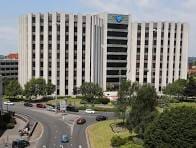
Ultimately, ARC Architecture’s successful proposal opted to retain and preserve the building's Brutalist facade.
Embodied Carbon Mitigation: Demolishing a concrete frame of this scale would have released thousands of tonnes of carbon dioxide into the atmosphere. Retaining the superstructure aligns directly with national net-zero goals and the BCP climate emergency strategy.
Skyline and Heritage Identity: While not formally listed, the octagonal wings are culturally synonymous with Poole's post-war identity. The chosen path modernizes the thermal envelope internally while preserving the external geometric silhouette.
Internal Layout Alteration: The deep, expansive office floor plates are being systematically partitioned into modern apartments. To combat the lack of natural light characteristic of deep-plan commercial layouts, the design leverages expansive glazing systems within the existing structural grid.
3. Engineering Obstacles and Site Challenges
Converting a 50-year-old bespoke office building built on reclaimed coastal land introduces severe structural and environmental engineering hurdles.
Asbestos Proliferation
Due diligence surveys confirmed a substantial presence of asbestos-containing materials (ACMs), primarily concentrated within the ceiling voids, textured coatings, and original thermal insulation panels. Because the residential conversion requires completely re-engineering the HVAC, plumbing, and electrical grids, a highly regulated, multi-million-pound hazardous material abatement program must be executed. This requires localized negative-pressure enclosures to safely strip the ceilings before any structural residential fit-outs can begin.
Structural Foundation and Sinking Issues
One of the core reasons BCP Council pulled out of purchasing the building was its underlying structural vulnerability.
The Sinking Mass: Built on soft, alluvial soils near the holes bay basin, the sheer, immense dead weight of the Brutalist concrete structure has caused documented differential settlement (sinking) over time.
Sub-Sea Level Basement Flooding: The building’s vast basement sits below the local water table. Throughout its history, it suffered from recurring dampness and active flooding, rendering it useless to Barclays for document storage.
To safely convert the property into a high-density "High-Risk Building" (HRB)—which draws extra scrutiny from the UK’s Building Safety Regulator—the developer’s structural engineers must introduce specialized foundation underpinning and an extensive, continuous internal waterproofing (tanking) system to handle water ingress in the lower levels.
4. Socio-Economic and Infrastructure Impact
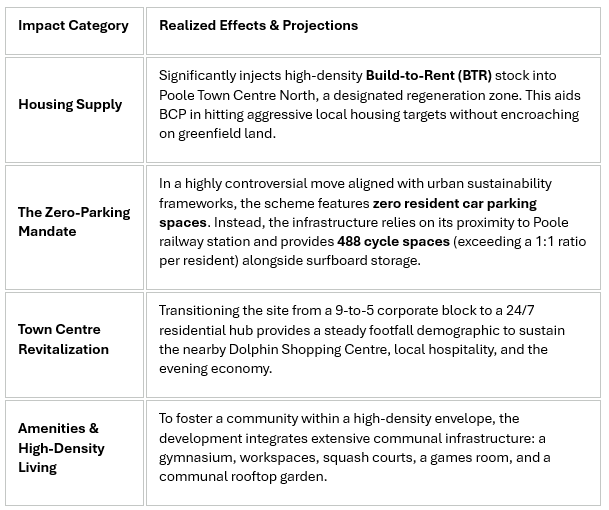
The insertion of 362 residential units into Poole's town center drastically alters the local socio-economic fabric.
Conclusion
The Barclays House conversion exemplifies the modern complexities of urban renewal. By choosing preservation over the wrecking ball, the project safeguards Poole's architectural history and minimises carbon expenditures. However, the ultimate viability of the development rests on the technical execution of its engineering remedies—specifically, neutralising a massive asbestos footprint and stabilising a heavy, sinking structure sitting right on top of a volatile water table.
YOU MIGHT LIKE

Updated Regularly
News From a Wider Area
POPULAR POSTS

Popular Events Will Appear Here
Popular BCP News Will Appear Here
Popular National News & Beyond
NEWSLETTER
It's FREE To Join Our Email Updates - Keep up to date with latest events, local news & articles!
Created with Systeme.io